How to Choose the Right Vending Machine for Your Business
How to Choose the Right Vending Machine for Your Business — match the machine to the American placement so the unit economics actually work.
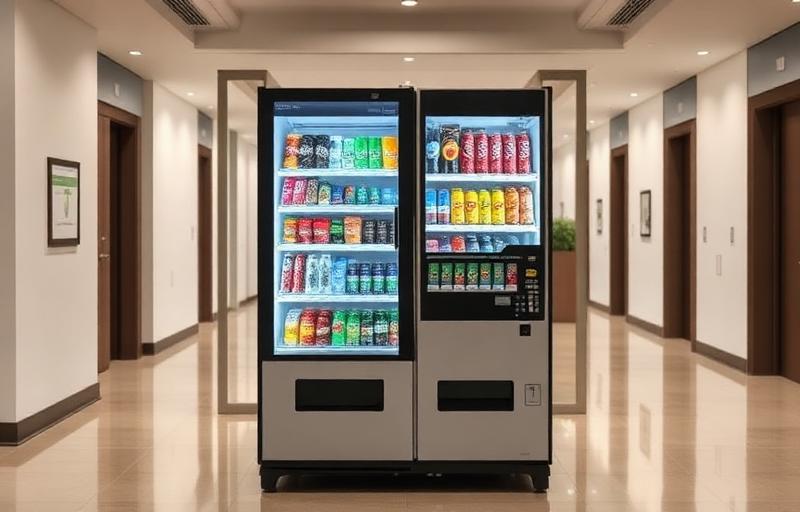
Choosing the right vending machine starts with the placement, not the catalog. A new American operator who picks the machine first and then hunts for a location will overspend on hardware and place it badly. Successful USA operators do the opposite: confirm the location, walk it, measure the foot traffic and the available footprint, and then specify the machine.
Step 1: confirm placement type and daily foot traffic. A 75-employee USA office wants different hardware than a 400-employee manufacturing plant. Office placements typically need a single combo machine with a broad product mix. Manufacturing placements typically need a snack + drink pair with deep product capacity.
Step 2: measure the available footprint. American host buildings vary widely in available vending space. Standard combo machine footprint: 39" wide × 31" deep × 72" tall. Standard snack-only: 39" × 33" × 72". Standard drink: 37" × 32" × 79". Never commit to a machine without confirming the host's exact space, including swing clearance for the door.
Across the USA, demand concentrates in a handful of high-growth metros. Operators report the strongest unit economics in Texas, Florida, California, Georgia, Arizona, North Carolina, with standout suburban pockets like Plano, TX, Frisco, TX, The Woodlands, TX, Doral, FL, Coral Gables, FL, Alpharetta, GA consistently outperforming national averages. USA host buildings show predictable footprint patterns by region. Newer Sun Belt office construction (Texas, Arizona, Florida) typically has dedicated vending alcoves that accommodate standard machine footprints. Older Northeast and Midwest buildings often have constrained spaces requiring slimmer or shorter machines (or two stacked combo units).
Step 3: select capacity for the placement velocity. A high-velocity USA placement (400+ employees) wants a high-capacity machine with 40+ snack selections and 40+ drink selections. A low-velocity placement (sub-100) is better served by a smaller-capacity unit — overstocking creates spoilage on slow-moving SKUs.
Step 4: specify the payment system. In the USA in 2026, every machine should ship with a modern Nayax or Cantaloupe card reader supporting Apple Pay, Google Pay, contactless credit cards, and traditional bill/coin acceptance. Skipping cashless to save $300 is a false economy — the lost sales from cash-only operation exceed the card reader cost within 90 days at most placements.
Step 5: choose new vs refurbished honestly. New machines make sense at Class A office buildings, hospitals, and any placement where the host explicitly requires it (some do — read the placement agreement carefully). Refurbished machines make sense everywhere else. The $3,000 to $5,000 per-unit savings from refurbished funds additional placements and accelerates route growth.
Step 6: confirm telemetry and reporting needs. Modern USA hosts increasingly expect operators to provide real-time sales reporting (which SKUs are selling, when the machine is empty, when service is scheduled). Both Nayax and Cantaloupe support this through their telemetry SaaS layer. Hosts that don't ask for it today often ask for it within 6 to 12 months of placement.
Common mistakes USA operators make on machine selection: choosing hardware based on price-only without considering placement velocity, choosing new when refurbished would serve identical revenue at half the cost, choosing oversized capacity for low-velocity placements (creates spoilage), and choosing dated mechanical machines without modern card-reader compatibility.
The right machine selection for the typical first USA placement in 2026: a refurbished AMS Sensit 3 combo machine with a Nayax NIO card reader, ~$2,200 to $2,800 all-in. This setup serves the majority of office, fitness, and small commercial placements profitably and gives the operator clean telemetry data to optimize the next placement decision.
Once you've mapped your numbers, plug them into our free ROI Calculator at /roi-calculator to pressure-test the deal. For multi-machine routes, financing scenarios, and 5-year projections, the Premium ROI tools on the same page give you the lender-ready view.